
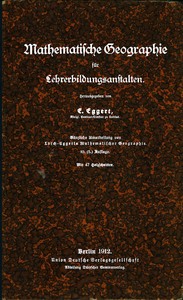
Mathematische Geographie für Lehrerbildungsanstalten by Erwin Eggert
Let's be clear from the start: this is not a novel. Mathematische Geographie für Lehrerbildungsanstalten is exactly what it says on the cover—a textbook on mathematical geography written for teacher training institutes in early 20th-century Germany. But that doesn't make it any less interesting to the right reader.
The Story
There's no plot, but there is a clear purpose. Erwin Eggert lays out the core mathematical principles behind geography in a systematic way. He starts with the Earth as a sphere, explaining latitude and longitude, the graticule that grids our planet. He moves on to map projections—the tricky business of flattening that sphere onto paper—and explains why different maps look the way they do. He covers time and time zones, the reasons for the seasons, and methods for calculating distances. The 'story' is the logical progression of ideas, building from a simple concept (the Earth is round) to the practical tools needed to teach and understand global spatial relationships.
Why You Should Read It
I found this book captivating for its clarity and its context. Reading it, you get a masterclass in foundational geography stripped of all modern fluff. It’s just the concepts, explained with diagrams and calculations. You can feel Eggert's intent: to equip future teachers with unshakable confidence in these fundamentals so they could pass that understanding on. It’s a peek into a classroom from over a hundred years ago. The prose is direct and methodical, which makes the complex ideas accessible. It’s a reminder of how much we still rely on these basic, beautiful mathematical relationships to make sense of our place in the world.
Final Verdict
This book is a niche treasure. It's perfect for history of education enthusiasts, geography nerds, and anyone who appreciates vintage pedagogical texts. If you enjoy seeing how complex subjects were taught in a pre-digital age, you'll find this incredibly satisfying. It's not for someone looking for a narrative or casual read. But if the idea of holding a clear, century-old instruction manual for understanding our planet intrigues you, then Erwin Eggert’s concise guide is a quiet, intellectual pleasure.
This work has been identified as being free of known copyright restrictions. You do not need permission to reproduce this work.
Emma Williams
1 year agoI stumbled upon this title and the flow of the text seems very fluid. This story will stay with me.


Melissa Smith
2 years agoA bit long but worth it.