
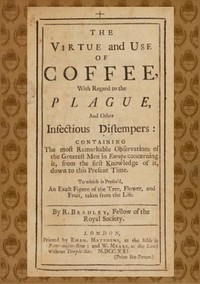
The Virtue and Use of Coffee With Regard to the Plague and Other Infectious…
Published in 1721, this book lands right in the middle of a fresh panic about the plague returning to Europe. Richard Bradley, a fellow of the Royal Society, isn't telling a story with characters in the usual sense. Instead, he's building a case. He observes that in cities hit by the plague, people who frequented coffee houses seemed to get sick less often. His 'plot' is the journey of his argument: he looks at the nature of contagion, discusses how diseases spread through 'bad air' (the miasma theory), and then gets to his main point.
The Story
The 'story' here is Bradley's logical progression. He describes the plague's horrors to set the stage. Then, he introduces coffee not as a drink, but as a substance that fortifies the body. He argues its fumes can purify the air in a room, and that drinking it strengthens the body's defenses. He even includes a 'recipe' for a plague-preventing coffee mixture. The conflict is between the terrifying, unknown force of epidemic disease and the hopeful, tangible solution Bradley believes he's found sitting in everyone's cup.
Why You Should Read It
This book is a time capsule. It's less about whether Bradley was right (we know now he wasn't, exactly) and more about watching the early scientific mind at work. You see the genuine effort to observe, hypothesize, and recommend a practical solution. It’s profoundly human—the desire to find safety in something familiar during a crisis. Reading it, you feel the fear of the era and the bold, almost charming, confidence in a simple remedy. It connects our world to theirs in a funny way; we still desperately want our daily rituals to be the key to health and longevity.
Final Verdict
Perfect for history buffs who love offbeat primary sources, or anyone fascinated by the history of medicine and science. If you enjoy books that show how people in the past made sense of their world with the tools they had, you'll be captivated. It's also a great, quick read for coffee enthusiasts who want the ultimate bragging right about their drink of choice. Just don't expect a novel—expect a curious, persuasive artifact that will give you a great story to tell at your next café visit.
This historical work is free of copyright protections. Enjoy reading and sharing without restrictions.






Charles Taylor
1 year agoFrom the very first page, the atmosphere created is totally immersive. Highly recommended.