
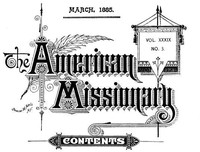
The American Missionary — Volume 39, No. 03, March, 1885 by Various
This isn't a book with a single plot. Think of it as a monthly report, a newsletter from the field. The American Missionary was the official publication of the American Missionary Association, a group deeply involved in education and aid after the Civil War. The March 1885 issue is a patchwork of voices. You get letters from a teacher in a cramped schoolhouse in Tennessee, describing her students' hunger to learn. There's a report from a mission in California, detailing the challenges faced by Chinese immigrant communities. Another entry might be from the Dakota territories, discussing the complex relationship with Native American tribes.
The Story
There's no main character or three-act structure. The 'story' is the ongoing work. Each article or letter is a small window into a different part of the country. One moment you're in the rural South, where the fight is for literacy and basic rights. The next, you're in a growing Western city, navigating cultural divides. The throughline is the mission itself: the effort to provide education, spiritual guidance, and practical help to people marginalized in post-war America. You see successes—a student graduating, a new church built—but also the constant frustrations of limited funds, societal resistance, and the overwhelming scale of the need.
Why You Should Read It
I loved it for its honesty. This isn't a polished history book looking back. It's the messy, present-tense reality. The writers aren't saints; they're people with strong beliefs, sometimes blinded by the prejudices of their time, yet genuinely trying to do good. Their perspectives are fascinating and often challenging. You get a real sense of the energy and the anxiety of that era. It makes history feel immediate. You're not just learning what happened; you're seeing how it felt to live through it, one difficult, hopeful day at a time.
Final Verdict
This is a niche but powerful read. It's perfect for history buffs who are tired of dry textbooks and want primary sources, or for anyone curious about the roots of social justice work in America. It's also great for readers who enjoy collections of letters and diaries. Be warned: it's a document of its time, so some language and viewpoints are dated. But if you can read it with that context, it's an incredibly rewarding glimpse into the heart of a nation still healing. Don't expect a page-turner; expect a thoughtful, sometimes sobering, conversation with the past.
This historical work is free of copyright protections. It is now common property for all to enjoy.
Kimberly Torres
2 months agoLoved it.
Susan Ramirez
10 months agoThe formatting on this digital edition is flawless.
Lisa Thompson
1 year agoHelped me clear up some confusion on the topic.
Barbara Jackson
1 year agoFinally a version with clear text and no errors.







Thomas Jackson
6 months agoI had low expectations initially, however it creates a vivid world that you simply do not want to leave. I learned so much from this.