
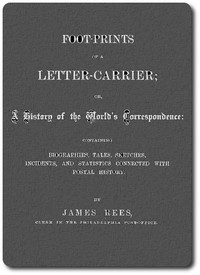
Foot-prints of a letter carrier; or, a history of the world's correspondece by Rees
Ever wonder how news traveled before the internet? Foot-prints of a Letter Carrier gives you the answer, and it's far more thrilling than you'd think. James Rees, who worked in the postal service himself, takes us on a journey through the entire history of written communication. He starts with ancient messengers and runs right up to the postal system of his own day. But the heart of the book beats in the 1800s, focusing on the United States. This isn't a dry policy manual. Rees fills his pages with the real people—the carriers, postmasters, and clerks—who made the system run against all odds.
The Story
There isn't a single plot, but a collection of interconnected tales that form one big adventure. Rees describes how mail routes were carved out of forests and across mountains. He shares stories of carriers facing down wolves, fording flooded rivers, and protecting their sacks of letters with their lives. He explains the odd rules and high costs of early postage, and how the fight for cheaper mail changed the country. You'll read about how news of the War of 1812 inched its way across the states, and how the postal service helped stitch the young nation together, one shaky delivery at a time. It's the biography of a service, told through the boots of the people who built it.
Why You Should Read It
This book completely changed how I see something I take for granted. Rees writes with the passion of an insider who loves his subject. His tone is conversational, like he's telling you stories over a fireplace. What grabbed me wasn't just the dangers, but the sheer human ingenuity on display. The system was messy, slow, and often unreliable, but it was a monumental achievement. It connects big history—wars, politics, westward expansion—to intimate, personal moments: a soldier's letter getting home, a business deal being sealed. It makes history feel tangible and deeply human.
Final Verdict
Perfect for history buffs who enjoy stories about everyday life, not just kings and battles. If you liked books like David McCullough's "The Wright Brothers" or Lars Brownworth's podcast "12 Byzantine Emperors," you'll appreciate this deep dive into a foundational part of American society. It's also great for anyone who's just curious about how things used to work. Fair warning: it's a 19th-century book, so the prose has a rhythm of its own, but Rees's enthusiasm is contagious. You'll never complain about a delayed package again after learning what it took to deliver the mail two hundred years ago.
This is a copyright-free edition. You do not need permission to reproduce this work.
Betty Sanchez
1 year agoJust what I was looking for.
Linda Jackson
1 year agoSolid story.






Susan Wright
1 year agoI had low expectations initially, however it challenges the reader's perspective in an intellectual way. Truly inspiring.